
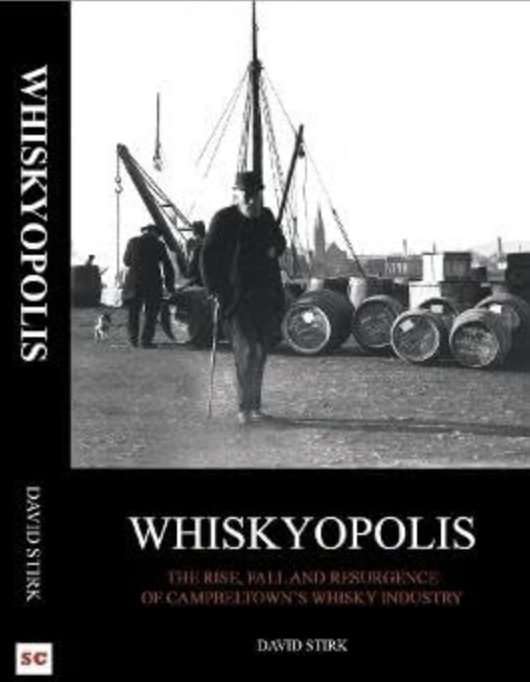
One of Scotland’s most remote mainland towns, Campbeltown also used to be know as “the Whisky Capital of the World” or “Whiskyopolis” as highlighted by the excellent book released by David Stirk recently (‘Whiskyopolis – The Rise, Fall and Resurgence of Campbeltown’s Whisky Industry’). I have recently read it and taken the opportunity to try and revise some of the information on this post, although the book provides much more information on each distillery, the region and whisky history of Campbeltown.
This is because Campbeltown used to be a hotbed of illicit distillation, since the end of the 18th century. It took the 1823 Excise Act to turn an illegal whisky boom into a legal one.

According to the author Angus Martin and his research published in his book ‘Campbeltown Whisky – An Encyclopaedia’, the most distilleries operating at any one time in Campbeltown legally (i.e. licensed) were 22. However, the list of Scotch whisky distilleries that have operated in Campbeltown since 1815, is over 30, even though only 3 of them are active today: Glengyle, Glen Scotia and Springbank.

The whisky industry in the coastal town of Campbeltown was largely driven not by native families from the area but rather by descendants of Lowland families which came to South Kintyre in the 17th century at the encouragement of the Campbells of Argyll, as Angus Martin reveals in his book ‘Campbeltown Whisky – An Encyclopaedia’. The three most prominent families were the Greenlees, Colvill(e) and Mitchell, with the Greenlees deemed to have been the most successful.

Campbeltown’s boom in whisky production was due in part to steam navigation as this allowed whisky to be shipped directly to Glasgow in just 9 hours. By 1891, Campbeltown, with a population of just 1,969 was reputed to be the richest town in Britain per capita.
“Campbeltown is certainly a most attractive place and we were charmed with is appearance. It is situated at the head of a beautiful bay, which is almost land locked and engirt by heath covered hills” Alfred Barnard

There are still many stories around the town from the days gone past and of the people involved in the scotch whisky business, such as Duncan MacCallum, who drowned himself in Crosshill Loch in 1930 and who was wealthy enough to be considered a multi-millionaire by today’s rates. The mystery behind his apparent suicide remains, as well as the stories of MacCallum haunting the Glen Scotia Distillery to this day.

Back in 1891, MacCallum was head of the consortium Stewart, Galbriath & Co that by 1905 held controlling interests in Benromach, Glen Albyn and Glen Dronach distilleries. He was also involved in building Glen Nevis Distillery back in 1877. The group purchased Glenside Distillery in 1908 and set up West Highland Malt Distilleries Ltd in 1919 to run (Glen) Scotia, Glen Nevis, Glengyle, Kinloch, Dalintober and Ardlussa distilleries, until the group’s bankruptcy in 1924.
In chronological order from the date of opening, below is a list of all of the Campbeltown distilleries that have operated under license. Interestingly, in 1815, there was only one legal distillery operating in Campbeltown, but only nine years later, there were already several others erected and in place.
- 1815 – Campbeltown Distillery
- the earliest of the distilleries established after a hiatus of 20 years in the legal trade, by John Mactaggart of the firm John Beith & Co.
- annual output: 60,000 gallons
- closed prior to 1923
- 1823 – Caledonian Distillery
- built on the opposite side of Big Kiln in 1823 by Peter Stewart & Co, licensee from 1828-40
- continued by James Johnstone under same name from 1842
- silent from 1851
- 1824 – Kinloch Distillery
- built for Lamb, Colvill(e) & Co, licensees until 1919 when acquired by West Highland Malt Distilleries Ltd
- annual output: 97,000 gallons
- taken over by D. MacCallum in 1923 and by 1928 the land and buildings were gifted to the Town Council

- 1824 – Lochhead Distillery
- built for A & R McMurchy & Co
- taken over in 1895 by J.B. Sheriff & Co Ltd, which was formed to acquire Lochhead, Lochindaal and sugar and rum plantations in Jamaica – company liquidated in 1920 and distillery purchased by Benmore Distilleries Ltd (also proprietors of Dallas Dhu)
- the distillery name is an anglicised form of ceann loch or ‘head of the loch’ as Campbeltown is known in Gaelic
- annual output: 111,000 gallons
- closed and lost in 1928 (rebuilt as a Tesco Supermarket)
- 1824 – Longrow Distillery
- originally owned by Colville, Beith & Co.
- Longrow closed in 1896 and the surviving buildings were purchased by J & A Mitchell & Co Ltd in 1971. One building is used as a warehouse and the other as a bottling plant for Springbank, who also released a heavily peated product under the name ‘Longrow’
- annual output: 40,000 gallons
- 1824 – Meadowburn Distillery
- founded by William Armour & Co who run the distillery until 1827 before being taken over by Kirkwood, Taylor & Co., which included Matthew Greenlees who was later connected with Hazelburn Distillery
- acquired by Robert Colvill & Co. in 1854 who continued at least until 1882
- the distillery is not included in Barnard’s book and it must have been closed prior to his visit in 1885
- 1825 – Burnside Distillery
- built by McMurchy, Ralston & Co. near the stream called ‘Witchburn’, this distillery was remote from the town, half a mile away on the road to Machrihanish (the golf course on the shores of the Atlantic)
- dissolved in 1828, reconstituted and continued at least until 1910
- annual output: 96,000 gallons
- distillery was closed and sold to United Creameries in 1919

- 1825 – Dalaruan Distillery
- built on Broad Street on the site of a brewery erected c. 1770 for Orr, Ballantine & Co
- David Colvill & Co. 1825-c.1910, when incorporated as a limited company
- annual output: 112,000 gallons
- demolished 1931
- 1825 – Hazelburn Distillery
- original site built in 1825 and distillery moved up the road to Millknowe in 1845
- Daniel Greenlees, who was also involved at Dalaruan Distillery, was involved in this project as part of Greenlees & Colvill
- Its capacity was considerably enlarged in 1863, and it exceeded all of the other Campbeltown distilleries
- the pioneer of Japanese whisky, Taketsuru Masataka (pictured below), and his Scottish wife Rita arrived in Cambpeltown in May 1920 to conclude his voluntary apprenticeship at Hazelburn
- annual output: 192,000 gallons but capacity of up to 250,000 gallons
- silent from 1925

- 1825 – Rieclachan Distillery
- built at the head of Longrow for Wyllie, Mitchell & Co – brothers Archibald and Hugh Mitchell were involved
- annual output: 70,000 gallons
- demolished 1936, there is now a Co-op supermarket in its location
- 1826 – Kintyre Distillery
- founded by John Beith with Beith, Ross & Co taking over from 1852 until 1876
- succeed by John Ross & Co. who continued until 1920 when distillery closed
- operated with Longrow from its opening until 1887
- annual output: 67,000 gallons
- Silent from 1921 and offered to the Town Council in 1926
- 1826 – Union Distillery
- built by John Mactaggart of McTaggart & Henderson who had also been involved with Campbeltown Distillery, and who passed away in 1832
- John Grant & Co took over from 1837
- ceased production in 1850 and partially demolished
- 1827 – Highland Distillery
- built on Broad Street, Dalaruan for Daniel MacTaggart & Co
- closed from 1859
- 1827 – McKinnon’s Distillery
- also known as Argyll Distillery and located at the Big Kiln on Lorne Street
- founded by Duncan McKinnon who died in 1835 although Duncan McKinnon & Co. continued until closed in 1844
- 1828 – Glenramskill Distillery
- the distillery was founded by McMurchy, Ralston & Co. and seems to have operated from 1837 until 1852 by Robert Ralston and was located to the south of the town
- advertised for sale in 1855
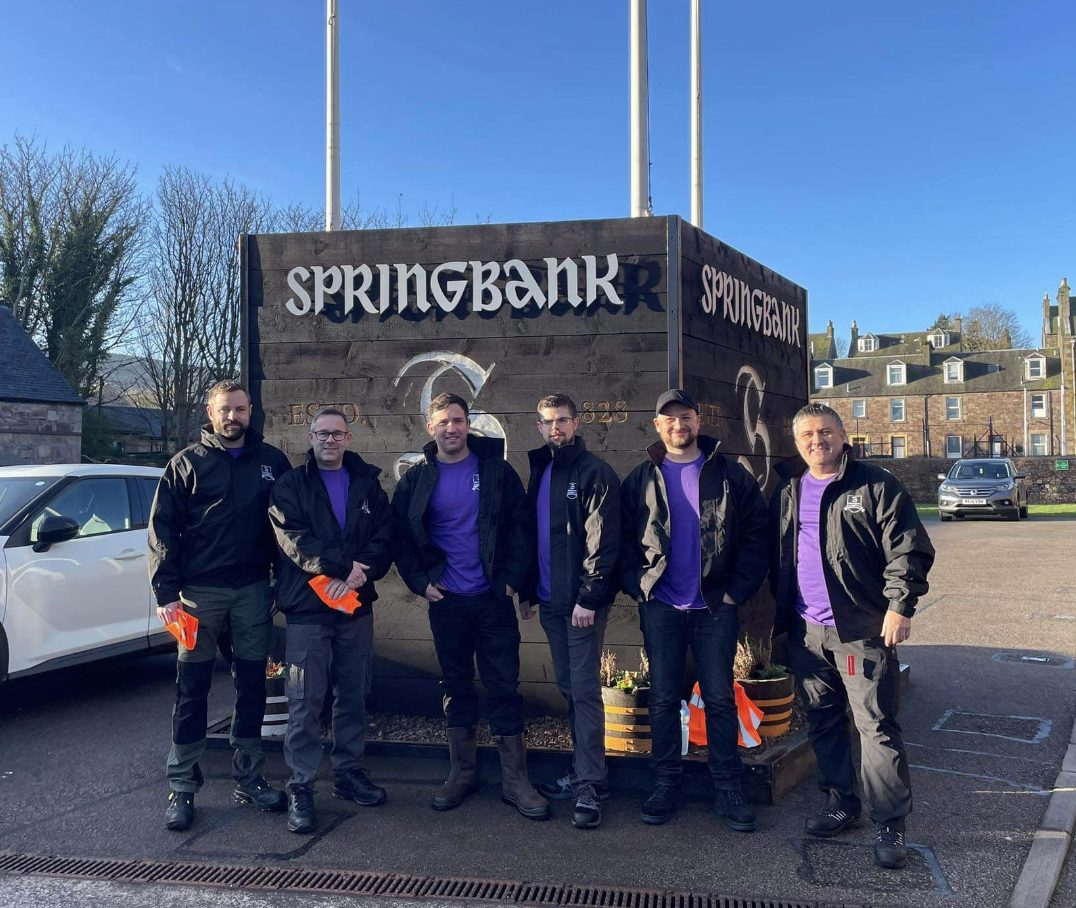

- 1828 – Springbank Distillery
- Alfred Barnard in his book gave 1828 as the year that the distillery was built, however there are also suggestions that this may have happened later according to Angus Martin, by the founding firm William Reid Jr & Co, which in 1837 was sold to brothers John and William Mitchell, operating as J & W Mitchell and beginning the family dynasty
- Due to disagreements, they eventually parted company in 1872 and Springbank was bought by John Mitchell who took his son Archibald into the business under J & A Mitchell
- Meanwhile his brother William Mitchell was involved after the split in building Glengyle Distillery
- silent from 1926 to 1935
- Mr. Hedley G. Wright (1931 – 2023) was the great-great-grandson of Archibald Mitchell and he was the person behind the acquisition of independent bottler William Caddenhead Ltd in 1972
- annual output: 145,000 gallons
- today’s annual capacity: 500,00 litres (source: Malt Whisky Yearbook 2025)
- 1830 – Lochside Distillery
- one of the shortest lived distilleries in Campbeltown with a span of less than 25 years (ceased production 1852)
- founded by Gilkinson, McKersie & Co.
- 1830 – Springside Distillery
- the distillery traded as John Colvill & Co and was the smallest of all distilleries visited by Alfred Barnard in 1885
- annual output: 30,000 gallons
- distillery closed in 1926
- 1830 – West Highland Distillery
- founding partners were Andrew & Montgomery
- rumoured to have gone out of business between 1852 and 1860
- 1830 – Glenside Distillery
- founded by John Marshall with David Anderson & Co taking over from 1837 until 1840 when David Anderson withdrew and partnership dissolved in 1844
- continued as the Glenside Distillery Co. with various changes of partners until 1908, when incorporated as a limited company
- Glenside was the first Campbeltown whisky to advertise in a local newspaper in 1921
- annual output: 70,000 gallons
- silent in 1930 and eventually demolished for housing development
- 1832 – Dalintober Distillery
- founded by Reid & Colville, including David Colville who was also involved in Dalaruan Distillery
- Dalintober signifies the ‘field of the well’
- acquired 1919 by West Highland Distilleries Ltd
- annual output: 120,000 gallons
- silent by 1926 with the land purchased for a housing scheme development
- 1832 – Meadowbank Distillery
- the original firm behind it was Peter Stewart & Co.

- 1832 – (Glen) Scotia Distillery
- founded as plain ‘Scotia’ Distillery by Stewart, Galbraith & Co, licensees until 1891 when acquired by Duncan MacCallum and incorporated as a limited company
- distillery sold in 1919 to West Highland Malt Distilleries Ltd and gone silent from 1928-1933
- the name was changed to ‘Glen Scotia’ in 1935 under the then ownership of Bloch Brothers Ltd, after MacCallum’s death in 1930
- in 1994, the distillery was bought by the Loch Lomond Distillery Company
- annual output: 85,000 gallons
- today’s annual capacity: 800,00 litres (source: Malt Whisky Yearbook 2025)
- 1833 – Broombrae Distillery
- built in 1833 by Edward Robertson but little known about the distillery which seems to have existed only for a short period of time until 1834
- 1833 – Lochruan Distillery
- built for Johnston & Co, the term ‘lochruan’ means the red loch, rua being the Gaelic word for red
- acquired by William McKersie in 1865, who established the Lochruan Distillery Co., the distillery was rebuilt and in 1875 passed on their father’s death to John and William McKersie
- experiments made with continuous distillation of malt whisky c.1910
- purchased in 1919 by James Buchanan & Co. and passed to DCL in 1925 when it went silent
- annual output: 85,000 gallons
- closed in 1925

- 1834 – Drumore Distillery
- used to stand in Drumore Farm and closed in 1847
- built for Templeton, Fulton & Co and there are a few Mitchell family links to some of the founding partners from Drumore, such as Mary Mitchell, the sister of Archibald Mitchell
- 1834 – Mossfield Distillery
- built in 1834 for Harvey & Hunter and situated in the Kirk Close, Longrow
- distillery name suggests that it was built on a boggy field or ‘bank of moss’ (i.e. peat)
- closed in 1837
- 1834 – Thistle Distillery or Mountain Dew Distillery
- originally named Thistle Distillery until new owners changed the name to Mountain Dew Distillery in December 1834
- operated by Hervey & McMillan initially and later by Peter Watson & Co. as licensees until 1837
- ‘Mountain dew’ (or ‘moonshine’) was a colloquial name for whisky
- ceased production 1837
- 1834 – Toberanrigh Distillery
- built by Alexander Wylie at No. 48 Longrow, who was the licensee until 1851 when acquired by a partnership including John Mitchell
- also known as Tober An Righ
- existed for less than 30 years (ceased production before 1860)

- 1837 – Albyn Distillery
- built by William McKersie next to the town gas works at the Roading, he retired in 1876 and passed the distillery onto his sons (William and John)
- annual output: 85,000 gallons
- a new warehouse was built in 1895 and this was followed by John’s death in 1904
- the company that owned the distillery since 1920 (William McKersie & Company Limited) went into liquidation in 1927
- 1844 – Argyll Distillery
- its 2nd manifestation was built in 1844 for Robert Colvill, Hugh Greenlees and Robert Greenlees Jr
- incorporated as a limited company c.1890, acquired c.1920 by Ainslie & Heilbron (Distillers) Ltd
- neighbouring Hazelburn Distillery
- annual output: 40,000 gallons
- emptied of its plant and machinery by 1929 with the premises sold in 1930
- 1868 – Benmore Distillery
- built by Bulloch, Lade & Co. and one of just two distilleries not built by local investors, the other being Ardlussa in 1879
- incorporated as a company in 1896, continued until 1920 when distillery sold to Benmore Distilleries Ltd (also owners of Lochhead, Lochindaal and Dallas Dhu), later acquired by DCL in 1928
- annual output: 125,000 gallons
- ceased production 1936 and building sold to West Coast Motors

- 1873 – Glengyle Distillery
- founded by William Mitchell a year after he parted company with his brother John at Springbank, building completed in 1873
- the distillery was sold off in 1919 to West Highland Malt Distilleries Ltd and went silent from 1925
- it only returned back under the Mitchell family fold in 2000, with whisky being produced in 2004 and eventually released under the ‘Kilkerran’ brand name
- one of the reasons for this is because the trade name ‘Glengyle’ is under the ownership of Loch Lomond Group, the current owners of Glen Scotia Distillery. In 1940, the Bloch Brothers purchased Glengyle Distillery and the ownership passed through a succession of companies over the years, however the trade name remains owned
- annual output: 90,000 gallons
- today’s annual capacity: 750,00 litres (source: Malt Whisky Yearbook 2025)
- 1877 – Glen Nevis Distillery
- built on land acquired from Gallowhill farm and owned by D. MacCallum & Co
- sold to Scotch Whisky Distillers Ltd in 1887, wound up in 1889 and sold back to D. MacCallum & Co
- by 1891 in the hands of Stewart, Galbraith & Co Ltd (owners of Scotia), later acquired by West Highland Malt Distilleries Ltd in 1921 before going silent
- annual output: 100,000 gallons
- ceased production 1923

- 1879 – Ardlussa Distillery
- built by Ardlussa Distillery Co., a James Ferguson & Sons company, who also owned Craighouse Distillery, Jura
- Last distillery built in Campbeltown (until Glengyle was rebuilt in 2004) and at the time, the 22nd operational distillery with neighbouring Glen Nevis Distillery, built 2 years earlier
- acquired in 1919 by West Highland Malt Distilleries Ltd, a consortium led by Robertson & Baxter
- annual output: 118,000 gallons
- silent from 1923 and demolished 1926 (except for its warehouse which remained in use until the 1970’s)
Other possible distillery from Campbeltown: Ballegreggan (1790-1797 by Donald McLean)

Note that all of the annual output figures – where available – have been sourced from the Alfred Barnard book published in 1887 and referenced on this list below. All of the output figures were quoted using gallons of whisky produced and if the British Proof Imperial Gallon was the equivalent to approximately 2.595 litres, then we can work out the capacity at the time. Therefore, one should be able to assume that the production in Campbeltown distilleries around 1885 was between 30,000 gallons at Springside Distillery and 192,000 gallons (capacity up to 250,000) at Hazelburn Distillery. Therefore, between 77,850 to 498,000 litres (capacity up to 649,000 litres of alcohol). This is much lower than the average single malt distillery in Scotland today, at an average of around 3.2 million litres produced annually.

For those visiting Campbeltown, you can even use Google search and then map function to identify the ‘lost distilleries’ – just google “campbeltown lost distilleries” and then open the map function (see picture above). I have not checked the accuracy but it seems to include: Springside, Kintyre, Highland, Longrow, Argyll, MacKinnon, Albyn, Hazelburn, Burnside, Ardlussa, Broombrae, Drumore, Lochhead, Kinloch, Benmore, Glen Nevis, Glenside distilleries.

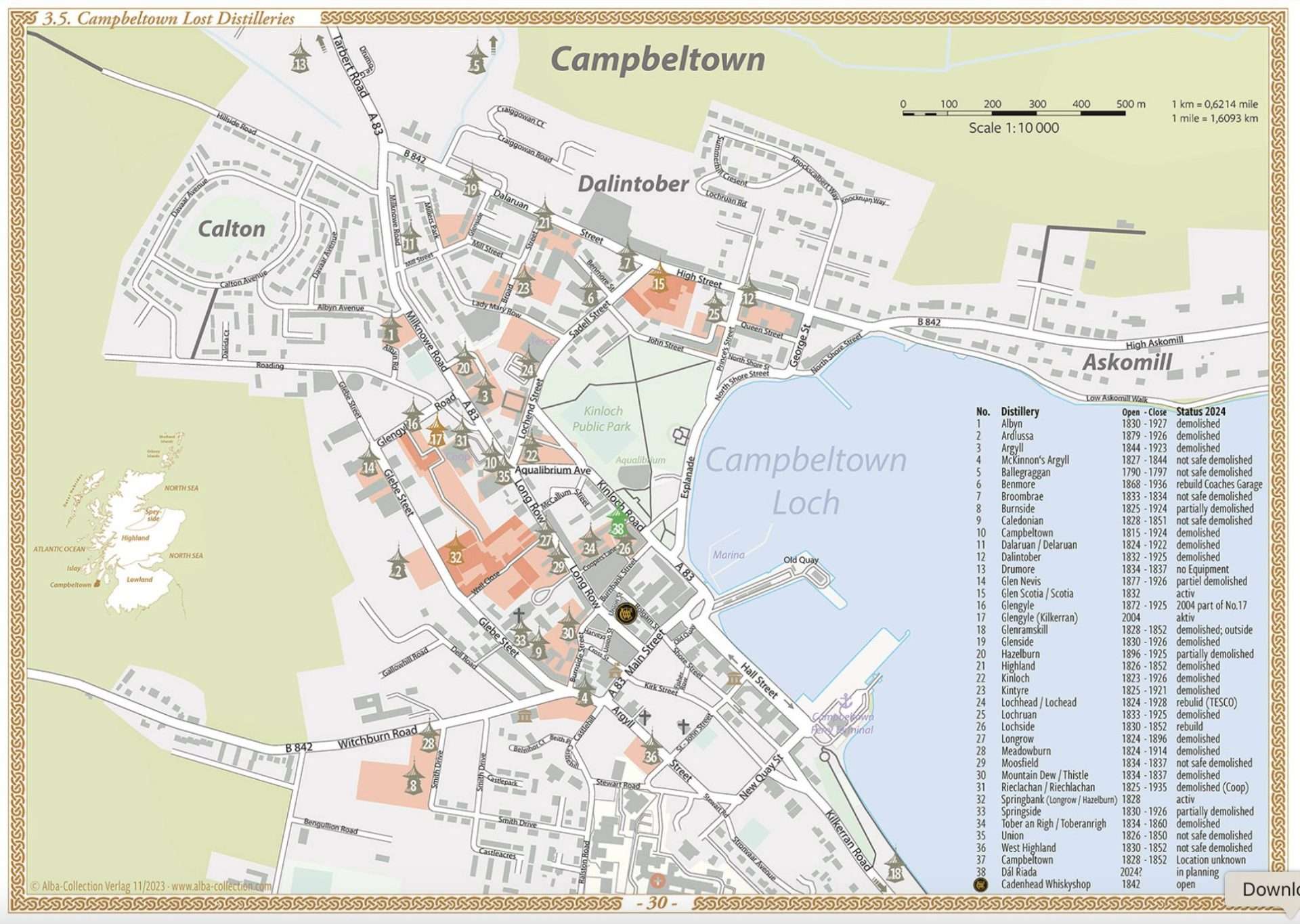
Please find the links below for further reference on Campbeltown – all of these were used for the information provided on this blog post:
- Inside the Cask blog post ’24 Hours in Campbeltown’
- Inside the Cask blog post ‘9 Surprising facts about Campbeltown’
- Inside the Cask blog post ‘Campbeltown and Scotch whisky’
- Event ‘Campbeltown Malts Festival’
- For reference – book “Campbeltown Whisky – An Encyclopaedia” by Angus Martin (pictured below)
- For reference – book “The Distilleries of Campbeltown” by David Stirk
- For reference – book “The Whisky Distilleries of the United Kingdom” by Alfred Barnard
- For reference – book “The Scotch Whisky Industry Record” by H. Charles Craig
- For reference – book “Whiskyopolis – The Rise, Fall and Resurgence of Campbeltown’s Whisky Industry’ by David Stirk





0 Comments