

The Right Cask Selection for You
A primary way of differentiation your product is through the selection of casks. The choice of casks used for maturation and finishing a whisky sets each product apart from the rest. Traditionally, whisky maturation has focused on the use of oak casks with different treatments such as char levels, toasting and wood seasoning duration. However, many distillers also finish or even fully mature in previously filled casks that held fortified, dessert style wines or spirits such as sherry, port, madeira, rum, cognac, and brandy amongst others. These used casks contribute to the sweetness, spice, floral and fruity notes desired by consumers in a whisky’s final character, without the need for undesired or regulated additives such as caramel colouring (typically used for colour consistency).
The main cask type used for Scotch Whisky production are ex-Bourbon casks
The main cask used in Scotland for whisky maturation are ex-Bourbon casks (ASB = American Standard Barrels). The production of bourbon in the USA is regulated and stipulates that Kentucky Bourbon is aged in new (also known as virgin) charred oak barrels. Any future changes to US distilling law allowing for the re-use of these casks by the bourbon producers would impact significantly on the availability and therefore, price of ex-Bourbon casks in the open market.  Consumer demand for bottled bourbon whiskies will also have an impact on the price of ex-bourbon casks as the market performance will dictate how many casks are emptied (for bottling) and later released to be sold to Scotland and other countries. The main market for bourbon and American whiskey in general remains its home market, the USA, as the chart below shows with data from IWSR from a few years back. This means that the overall performance and sales of bourbon in their home market will have a disproportionate impact on the availability of ex-bourbon casks.
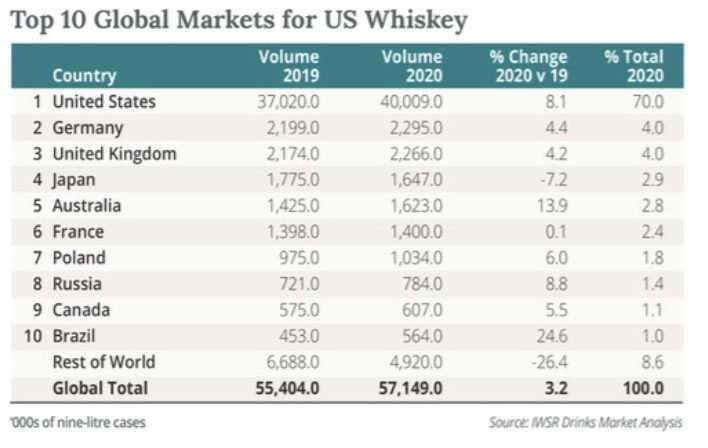
Aside from the potential negative impact on bourbon sales abroad of possible higher tariffs being applied to imports of other spirits to the USA from 2025, an example of a bourbon sales slowdown was also reported recently on The Spirits Business as MGP Ingredients (who supply whiskey to many brands in the USA), will scale down production in 2025.
“In response to the softening American whiskey category trends and elevated industry-wide barrel inventories, in 2025 we plan to further lower our net ageing whiskey put away, scale down our whiskey production, and optimise our cost structure to mitigate lower production volumes,” David Bratcher, CEO and President, MGP Ingredients
Given that until recently the price for used ex-bourbon casks had increased – linked to lower supply in relation to the global demand – one would expect that this trend will continue with ex-bourbon casks prices increasing further and potentially even surpassing the price for entry level new oak casks.
As for useage, these ex-Bourbon casks (and other cask types) will be typically used multiple times for maturation in the production of Scotch whisky and referred to it as a 2nd fill, 3rd fill or simply as a ‘refill cask’ (i.e. a cask used at least twice for for whisky maturation), although over time they can become exhausted and possibly rejuvenated for further use, for example by using a De-Char/ Re-Char (DCRC) process.
In times of shortage of casks the focus can shift to the rejuvenation of older casks to try and improve their quality
During times of plentiful supply and low prices this is not required – assuming you can source and buy ex-Bourbon casks from trusted suppliers. This rejuvenation process sees an older exhausted cask have its ends removed before having its inner surface removed by various methods. Wire brush, and various mechanical devices are all in use to remove the old exhausted char and upper toasted wood layer, thus removing the minimum amount of wood required to maintain the cask integrity before a re-char takes place.  The most sought after type of cask in Scotch whisky production currently are ex-Sherry casks
In particular, those sherry casks that have spent their entire life inside a bodega (a wine cellar/ warehouse), these ‘bodega casks’ have been used to mature sherry for years or even decades as part of the solera systems in Jerez. Since 2015, the Consejo Regulador of the Denomination of Origin “Jerez-Xérès-Sherry” has certified casks seasoned with genuine sherry. The price, and in particular, the availability of these cask types can be very limited.
The change in law stating that all sherry had to be bottled in the DO region also resulted in distillers losing some of their supply of casks and as a result, they started to work with bodegas and Spanish cooperages (tonelerias) in the Andalucia region to make and season casks for their own specifications, i.e. ‘seasoned casks’. Today, most seasoned casks are made from new European (and also American) oak, ‘seasoned’ with oloroso or PX.

The Scottish company Edrington has taken a step further in securing their supply of ex-sherry casks by investing in a number of tonelerias (cooperages) and bodegas in Jerez, Spain as reported on WhiskyDrinks.net. This will guarantee the quality of casks being seasoned locally and supplied for their main Scotch whisky brands, in particular for The Macallan single malt, especially given its association with ex-sherry casks.
In future, this will also provide them with a competitive advantage and it may mean that other Scottish distillers will have to secure alternative supply contracts over the medium to long term with cooperages that are still independent and/or distillers will have to look at alternative cask type options.
One alternative source for Scottish producers are the ex-Fortified Wine Casks from Portugal
Traditionally in Scotland, both ex-Port and ex-Madeira European oak casks would have been used due to availability and transport of these types of cask to the UK. Aside from these, there are also other oak casks available from their use in the production of Portuguese fortified wines, such as Moscatel (produced in the Douro and Setúbal regions) and Portugal’s least well known, Carcavelos (produced since the 15th century in the smallest demarcated region in the country, in the municipality of Oeiras).

Port wine can be white, red or rosé however red port is the most traditional and commonly available – depending on the characteristics of production, ageing process and style these can be characterised as:
- Ruby: the youngest of Port wine varieties, with a bright red colour and fruitiness on the palate. Premium rubies are aged in wood for up to six years. In the world of Ports, the classification of vintage doesn’t refer to the age of the wine. Vintage Port is made entirely from the grapes of a declared vintage year, highlighted as such for its exceptional qualities. Naturally, not every year is declared vintage in the Douro region and thus Vintage Ports come at a steep price. Late-bottled vintage Port (LBV) is a wine from a single year, always bottled four to six years after harvest.
- Tawny: after aging in oak barrels for two to three years, Port Tawny is transferred to French oak barrels. Due to the greater contact it has with wood, it matures more quickly and its flavour ends up being more nutty and complex. Great Tawny Ports can be aged for up to 40 years.

New (Virgin) American, French and European Oak Casks have the potential to develop further with Scotch
The increase in the price of ex-Bourbon casks has brought them closer to entry level new oak casks and this may result in more distillers and producers to consider using these casks.
These are casks that have had no other filling before the whisky is stored inside them and can be very ‘active’, imparting both colour and flavour which will vary depending on the production method (toasting and charring), source of the oak (e.g. American oak will have less tannins than European oak) and length of wood seasoning or ‘maturation’ – this term refers to the time spent outdoors by the wooden staves before being made into a cask, reducing the humidity level; developing mold which favours the creation of aromas and reduction in tannins and astringency; whilst also changing the wood structure.
“If used judiciously, virgin oak can contribute some rather interesting flavours to the final product, and I currently have a number of products in my whisky ranges which include an element of virgin oak-matured/finished whisky in the final recipe.” Dr. Bill Lumsden (as reported on scotchwhisky.com back in 2014)

Other casks available for Maturation and Finishing
Other examples include Chinkapin oak, Ex-Wine barriques STR (Shaved, Toasted, Re-charred) – popularised by Dr. Jim Swan within the Scotch whisky industry, Ex-Peated casks (used first within Scotland with a peated/ smoky Scotch whisky and then in other categories), Ex-Rum casks, Ex-Cognac casks, etc

Cask Sizes
The sizes of casks can vary from Octaves (50L or even 64L), Quarter Casks (125L), American Standard Barrels (200L), Cognac Barrique (300L), Wine Barrique (225L), Hogsheads (250L), through to the larger sizes such as Sherry Butts and Puncheons (500L), Port Pipes and Madeira Drums (650L).  A few cask examples. Source: Tanoaria Josafer (Portugal)
More to follow on the next Inside the Cask blog post – ‘Whisky Maturation – It is All About the Oak Casks: ‘Sources of Oak and Heat Treatment’
The previous related blog post was ‘Whisky Maturation – It is All about the Oak Casks: Coopers and Where to Source’
After all the work involved in its production, it is time to let the new make spirit rest until it emerges out as Scotch whisky…

For Reference and further reading:
- ISC Barrels – Oak Species for Cooperage
- ISC Barrels – Barrel Profiling – Part 1
- ISC Barrels – the Role of Oxygenation in Barrel Aged Spirits – Part 1
- ISC Barrels – Char Level and Double Barreling
- ISC Barrels – Extractive Concentration Changes During Maturation
- ISC Barrels – Esters: The Unsung Heroes of the Single Barrel
- ISC Barrels – Oak 101: Seasoning and its Impact on Flavour Development
- ISC Barrels – European Oak: Exception Flavour, Exceptional Value
- ISC Barrels – Used Barrel Cooperage vs. Barrel Broker: Understanding the Difference
- Independent Stave Company (ISC) Barrels (USA)
- Tonnellerie Quintessence (Bordeaux, France)
- Tanoaria Josafer (Esmoriz, Portugal)
- Inside the Cask – Quarter Cask Insights #1
- Inside the Cask – Quarter Cask Insights #7
- Inside the Cask – the Auld Art of Coopering
- WhiskyDrinks.net – Edrington secures Sherry Casks
- The Whiskey Wash – The Heat of the Moment: Charred Barrel vs. Toasted Barrel
- The Glenlivet – Whisky Maturation: The Importance of Oak Cask
- Publication – The Economic and Fiscal Impacts of the Distilling Industry in Kentucky prepared for the Kentucky Distillers’ Association
- Publication – Kentucky Bourbon Whiskey by Michael R. Veach





0 Comments